
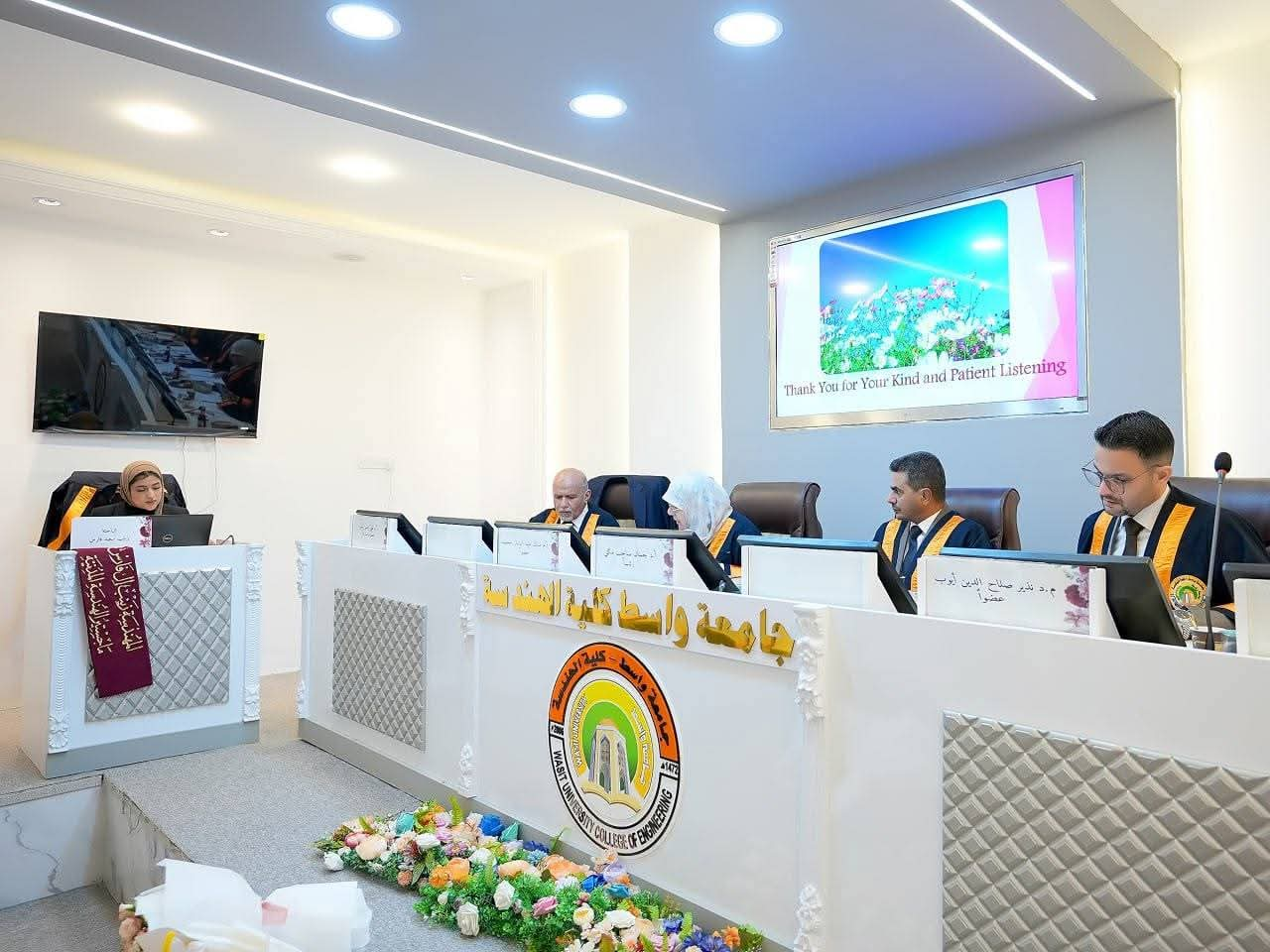
The Department of Civil Engineering at the College of Engineering, University of Wasit, held the defense of the master’s thesis entitled “Modeling of Flow Patterns and Natural Erosion Processes Downstream of Kut Barrage Using HEC-RAS and ADC,” submitted by Zainab Saeed Faris.
The study aimed to model and analyze flow patterns, erosion, and sediment deposition in the Tigris River downstream of Kut Barrage. It assessed the effects of excavating 30-m-wide channels through river islands at three depths—1.0 m, 1.5 m, and 2.0 m—compared with the river’s natural condition, to evaluate how these geometric changes affect flow efficiency and sediment transport.
The study used hydraulic, topographic, and sediment data, together with an analysis of bed-sediment samples, to construct the model, run simulations, and compare the different excavation scenarios.
Model calibration showed strong agreement between observed and simulated values, with both NSE and R² reaching approximately 0.983. A Manning’s roughness coefficient of n = 0.030 produced the lowest RMSE value, 20.027, supporting the use of the model to analyze the scenarios under study.
The results showed that channel excavation increased flow velocity in most cross-sections by 7–18% at a depth of 1.0 m and 17–31% at 2.0 m. The 1.5 m scenario produced a non-uniform response because of geometric and morphological differences between cross-sections.
The average effective depth decreased by 5–11% at 1.0 m, 9–18% at 1.5 m, and 16–27% at 2.0 m. In contrast, shear stress increased in most cross-sections by 8–25% at 1.0 m and 18–45% at 2.0 m, while some cross-sections responded differently at 1.5 m.
The results also showed average increases in erosion of 17.1% at 1.0 m, 48.2% at 1.5 m, and 74.6% at 2.0 m. Meanwhile, sediment deposition decreased by an average of approximately 5.2% at 1.0 m, 3.5% at 1.5 m, and 18.5% at 2.0 m. These findings reflect the relationship between hydraulic changes and the flow’s capacity to transport sediment.
The study concluded that, overall, the 2.0 m excavation scenario produced the most consistent response among the scenarios examined in improving flow movement, increasing sediment transport capacity, and reducing sediment accumulation. It also emphasized the importance of periodically monitoring erosion and deposition after excavation works.
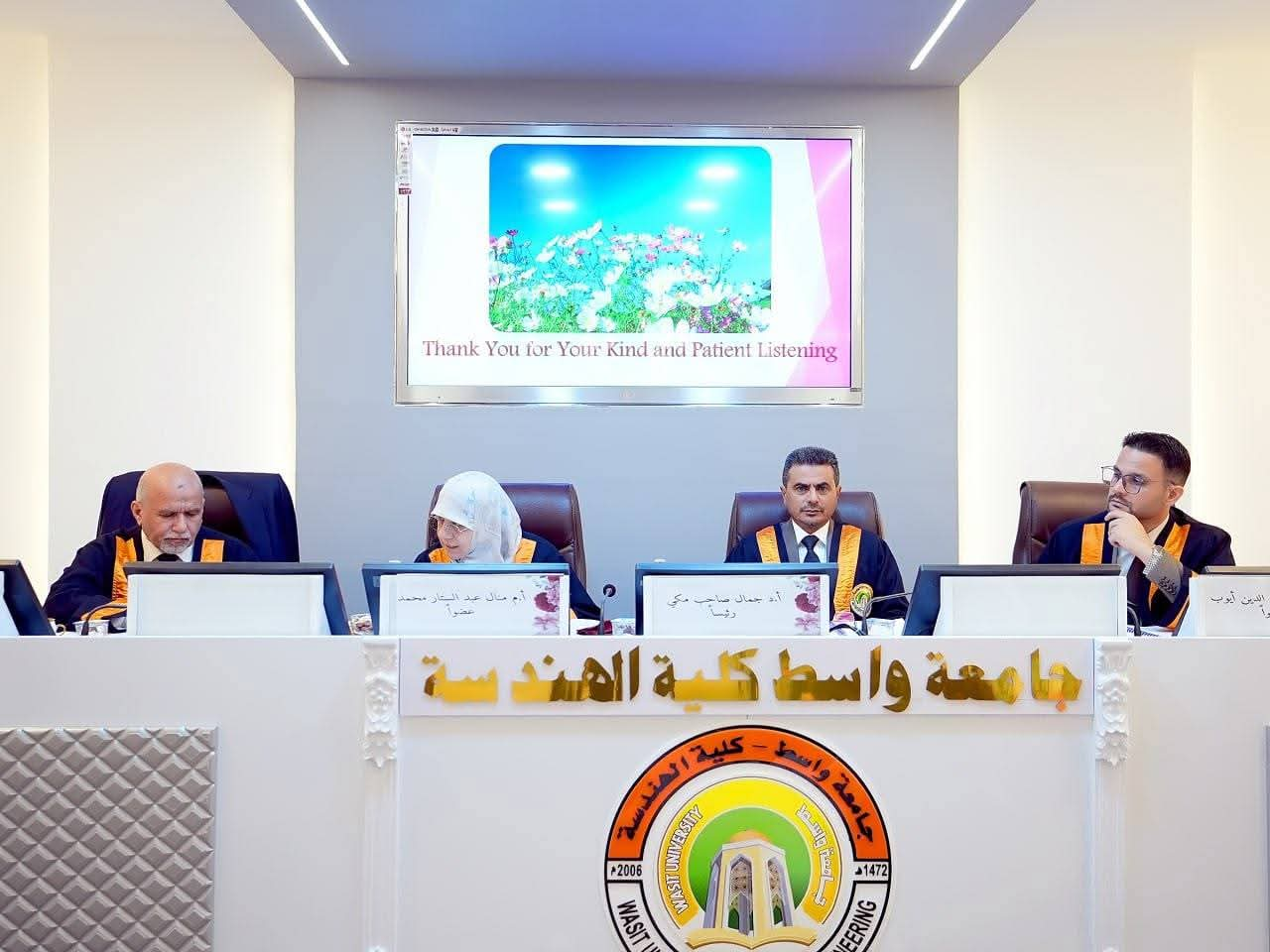
The examination committee comprised:
Prof. Dr. Jamal Sahib Makki — Chair.
Assistant Professor Manal Abdul-Sattar Mohammed — Member.
Lecturer Dr. Natheer Salah al-Din Ayyoub — Member.
Prof. Dr. Ali Nasser Hilu — Member and Supervisor.
No comment